Customer Media Measures Like Paid Media
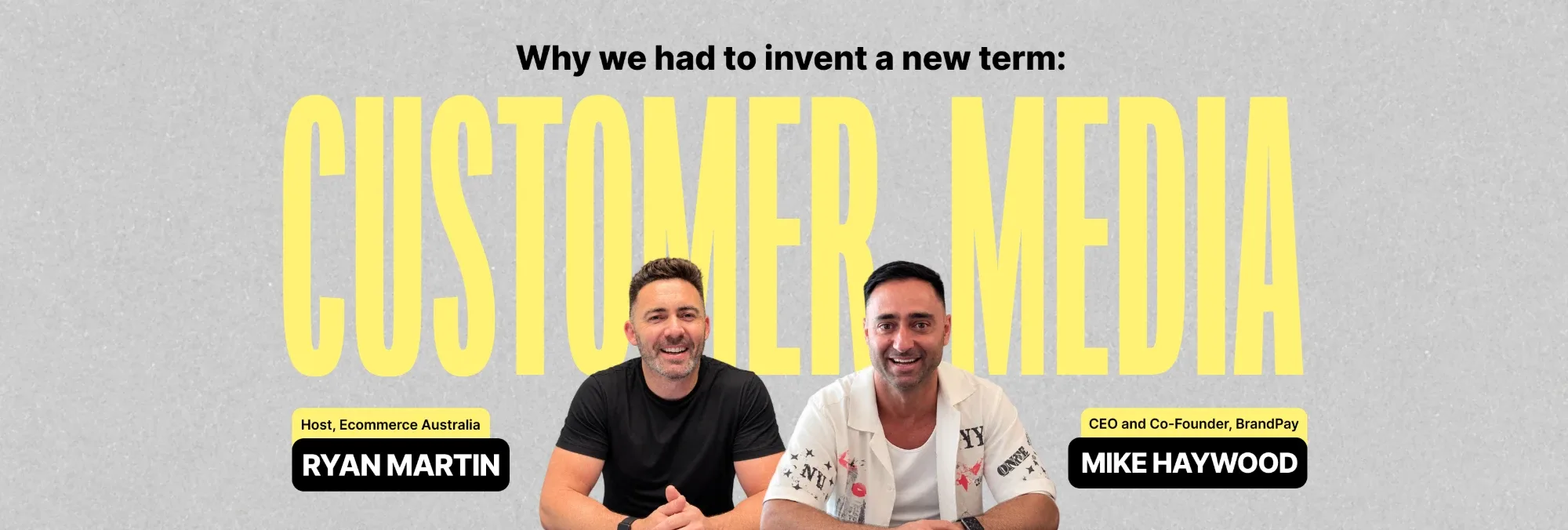
BrandPay co-founder Dr Mike Haywood joined Ryan Martin on eCommerce Australia to explain why rewarding real customers is a different discipline from creator marketing, how the results stack up against paid social and why AI search is making authentic third-party content so valuable.
Ryan Martin and Dr Mike Haywood. Episode courtesy of eCommerce Australia.Is customer media just another name for UGC?
We coined the term customer media because we believed something was missing from the way brands think about social media.
UGC originally meant content created by everyday people. Today, it increasingly refers to paid creators producing content to a brand brief. Meanwhile, as Mike points out, fewer than 5% of social media users create around 95% of the content. That’s an enormous majority of people whose voices are barely being heard.

Customer media is about changing that. It’s built around real customers who already buy from brands, love their products and have experiences worth sharing. And as we’ve learned at BrandPay, what motivates them to post is very different from what motivates professional creators.
Mike shares how BrandPay’s original dollar-per-like reward model, inspired by an experiment at his own holiday retreat, revealed something fascinating about human behaviour. Even a small amount of uncertainty about how much someone might earn can be enough to stop them from posting. A fixed reward changes that equation, making the decision much simpler.
It’s also why customer media is attracting the attention of performance marketers. When thousands of real customers can share their experiences with relevant audiences, the opportunity goes far beyond content creation. It becomes a measurable, scalable way for brands to reach new customers and drive growth.
Does paying customers to post count as advertising?
The short answer is yes, although Mike makes an interesting distinction between advertising created by professional influencers and the everyday moments customers choose to share.
Any customer who has the opportunity to earn a reward needs to include #ad in their post, even if the brand ultimately decides not to reward it. As Mike explains, advertising regulations were largely written with influencers in mind, but they apply to everyday customers too.
What’s interesting is how little this changes the nature of the content. A paid creator is typically producing something specifically to promote a product. A customer is sharing a moment from their everyday life, where the brand happens to feature.
Mike gives a great example of someone heading out for a 6am run around Albert Park in their LSKD shorts. Their post is far more likely to be about the struggle of getting out of bed that early than anything to do with the shorts themselves. The brand is part of the moment, rather than the subject of the story. And that’s precisely what makes these posts so relatable.

There’s also an important difference in how content rights work. Customers retain ownership of everything they create, while brands receive a non-exclusive licence to use approved content across their own channels and paid advertising. Traditional creator agreements often come with restrictions on how long or where content can be used, making customer media a particularly valuable source of content for brands.
How do you measure customer content against paid social?
Perhaps unsurprisingly, the answer is with exactly the same metrics brands already use to measure their paid media. BrandPay’s integration with Meta gives brands visibility into impressions, clicks and spend for every approved post, making it possible to calculate CPM, cost per click and return on investment, and compare performance directly against their existing paid channels.
Mike shares that customer media is delivering a cost per click around 50% lower than traditional paid media. Even that figure doesn’t tell the full story, since it only accounts for clicks within the BrandPay app, where customers can discover rewarded content from people nearby, and excludes clicks generated by those same posts on Instagram. The actual cost per click could therefore be considerably lower.
Mike also raises a bigger question: how do you measure the impact of thousands of customers talking about your brand? People rarely make a purchase after seeing a single piece of content, which is why BrandPay is working on integrations with attribution platforms like Triple Whale to understand how customer media influences performance across other marketing channels.
BrandPay can also track when and where customers spend their rewards, helping brands connect content creation to subsequent purchases, including repeat orders. This gives brands a much clearer picture of how customer media contributes to growth over time.
How much does BrandPay cost, and how do customer rewards work?
The BrandPay model is fairly straightforward. Brands pay a 25% fee on top of each approved reward, with no subscription or setup costs. So if a customer earns $10 for a post, the brand pays $12.50. Brands can fund their BrandPay wallet upfront, much like a paid media account, or pay as they go through Stripe.
The more interesting question is how much to reward customers in the first place. BrandPay looks at a brand’s cost of goods, average order value and existing CPM and CPC to recommend a starting point that makes commercial sense. For example, LSKD currently rewards customers $16 for a Reel and $3.50 for a Story, with each customer eligible once a week.
Mike makes an interesting point about the psychology of rewards. When the amount is too small, customers tend to see it as a discount on something they were already planning to buy. A more generous reward can actually change their shopping behaviour, encouraging them to add something extra to their basket or come back for another purchase.
While brands fund rewards in cash, customers receive their earnings in a BrandPay wallet linked to a Mastercard in Apple Wallet. Those rewards offer the most value when spent with the brand that issued them, although customers can also spend across the BrandPay network. They can’t withdraw the money to a bank account.
That creates a particularly interesting commercial dynamic: 85% of rewards are spent back with the brand that issued them, on average within five days. For brands, customer media can generate content, reach new audiences and bring customers back to shop, all through the same reward.
What kind of brands does customer media work for?
You might be surprised by just how many brands fit naturally into the things people already share about their lives. From the clothes they wear and the skincare they swear by to the furniture in their homes and the treats they buy for their pets, there’s an enormous range of everyday moments where brands already have a place. As Mike points out, people love filming their dog’s reaction to a delivery of treats. A can of soft drink might be a harder sell today, but he expects that to change as sharing everyday purchases becomes more common.
But there’s something bigger at play here. Community is becoming one of the most valuable things a brand can build. From emerging businesses to the world’s largest FMCG companies, everyone is looking for ways to create a stronger sense of community around their products. And for good reason. People who genuinely love a brand, talk about it and recommend it to others can be far more influential than anything the brand says about itself.
Mike makes an important distinction between having an audience and having a community. A million Instagram followers might look impressive, but with organic reach declining, that number alone tells you very little about how connected people feel to a brand. An active Facebook group, an engaged email list or a loyal customer base that regularly talks about your products can be far more valuable. The brands seeing the strongest results with customer media are the ones bringing those existing communities into the experience, through their websites, emails and customer groups, and giving people a reason to participate.
Mike encourages smaller businesses to start with whatever they have, even if that’s one customer post in the first month. One becomes three, then ten, and over time, those individual moments of advocacy can help build a much bigger community around the brand.
BrandPay is also exploring how customer media can work for brands that sell primarily through distributors or retailers, including everyday FMCG products where customers don’t necessarily shop directly with the brand. For these businesses, the opportunity is particularly interesting: building a direct relationship with customers, encouraging them to share their experiences and creating a sense of community that extends well beyond the point of purchase.
Why does third-party content matter for AI search?
AI is changing how people discover brands, and what other people say about you is becoming increasingly important.
Think about how someone might search for a new pair of running shorts today. Instead of scrolling through pages of Google results, they might ask ChatGPT or Claude for a recommendation. As Mike explains, those answers can be influenced by what real people are saying about brands across the internet, from reviews and conversations to social content. Ryan Martin makes a similar point from an SEO perspective: what everyone else says about your brand is becoming an increasingly important part of how you’re discovered.

“Everyone’s trying to be authentic, but just use your customers. You can’t get any more authentic than someone that is not trying.”
Mike Haywood · 39:15
There’s also a fascinating difference in how long that content can continue to create value. A paid ad stops delivering when the budget runs out. A customer’s post can remain discoverable long after it was originally shared, potentially influencing future searches, recommendations and purchasing decisions. Melbourne agency Thinkerbell calls this the infinite half-life of third-party content, an idea that becomes particularly interesting as AI changes how people find and evaluate brands.
Social media feeds are filling up with AI-generated content, and audiences are becoming increasingly sceptical of anything that feels too polished or manufactured. Mike shares a particularly telling example: some creators now deliberately shake their phones at the start of a video to make it look spontaneous. It’s an interesting reflection of where social media is heading, when even authenticity is being carefully staged. Meanwhile, everyday customers are sharing real, imperfect moments without giving it a second thought.
As Mike puts it, a real customer genuinely talking about your brand is becoming one of the rarest and most valuable things in marketing. With AI increasingly influencing how people discover and choose brands, those authentic customer voices have the potential to become even more valuable.
Moments
Related articles